A clinic group in Salmiya signs up for the platform you sell. The owner reads reports in Arabic, the receptionists are from Egypt, India and the Philippines, and the marketing manager wants the system to look like the clinic’s own app. Within a week the group also asks why reminder texts are not arriving and whether the invoices can show fils properly. HighLevel can serve that client well, but not with the default screens and not with a setup copied from a client in Texas or Dubai.
This guide is for agencies that sell white label HighLevel (also called GoHighLevel or GHL) to businesses in Kuwait, whether you work from Kuwait City or Hawalli or serve Kuwait from elsewhere in the Gulf. It covers what makes Kuwait different: an expatriate-heavy workforce, Arabic and English side by side, a three-decimal currency, the Friday and Saturday weekend, SMS sender rules, the new digital commerce law and health advertising rules. It ends with a step-by-step setup, the common mistakes and what a branded dashboard costs in dinars.
What makes white label HighLevel in Kuwait different?
Kuwait is a compact, wealthy, highly connected market where the people who own a business and the people who use its software often speak different first languages. That single fact shapes more of a Kuwait HighLevel setup than anything else, followed by the dinar’s three decimals, the Gulf working week and a fast-changing set of commerce rules.
Start with the people. Kuwait’s population passed 5 million in mid-2025, with Kuwaiti citizens at about 1.55 million and expatriates at about 70 percent of the total, according to Public Authority for Civil Information (PACI) figures reported by Gulf News. Indians are the largest expatriate community and Egyptians the second largest, which already tells you that a typical office mixes English and Arabic speakers.
The workforce split is even sharper. Non-Kuwaitis make up about 96.4 percent of the private-sector workforce, while most working Kuwaitis are employed by the government, as Kuwait Times reported from official labor data. For an agency, this means the person who signs the contract and the people who answer leads in HighLevel are rarely the same group.
Infographic
Kuwait for HighLevel agenciesby the numbers
5.1M
residents of Kuwait in mid-2025, about 70% expatriates
(PACI, via Gulf News)
96%
of private-sector workers in Kuwait are non-Kuwaitis
(Kuwait Times)
5.00M
internet users in Kuwait in October 2025
(DataReportal, Digital 2026 Kuwait)
15
dashboard languages, with Arabic right to left
(GHL Dashboard Builder)
Sources: PACI via Gulf News (2025); Kuwait Times; DataReportal Digital 2026 Kuwait; GHL Dashboard Builder.

The third layer is how connected the market is. DataReportal counted 5.00 million internet users and 4.44 million active social media user identities in Kuwait in October 2025 in its Digital 2026 Kuwait report. Residents also handle government paperwork on their phones: the unified government app Sahel passed three million users in late 2025, as MEA Tech Watch reported. Kuwait clients are used to polished apps, and they notice when a business tool looks unfinished.
The identity layer comes first everywhere: your logo, a custom login domain and legal links under Settings, Company, Whitelabel. If that is not done yet, our guide on how to white-label HighLevel walks through it. This guide assumes that layer is in place and covers what a Kuwait client notices next. Our Kuwait market page summarizes the conventions we apply for Kuwait in one place.
Who buys a white label HighLevel in Kuwait?
Most Kuwait agency books are built from six kinds of client: clinics and aesthetic centers; salons, spas and gyms; online-first shops selling through Instagram and other social apps; restaurants and food brands; training and education providers; and professional firms. Each needs a different mix of Arabic and English, different menu words and different rules in its automations.
| Kuwait client type | What shapes the setup | What it changes in HighLevel |
|---|---|---|
| Clinic, dental or aesthetic center | Ministry of Health rules on advertising prices and services, sensitive patient data | Patients in the menu, an approval stage before campaigns, careful demos |
| Salon, spa or gym | 2025 Ministry of Health rules for beauty operators, booking-heavy days | Bookings and Members in the menu, calendar-first dashboard, reminder flows |
| Online-first shop (Instagram, Snapchat, TikTok) | 2026 digital commerce registration and disclosure duties | Orders in the menu, product pages with full price and contact details, DM-to-pipeline flows |
| Restaurant or food brand | Delivery apps, catering orders, weekend peaks on Friday and Saturday | Orders and Catering pipelines, weekend-aware automations, review requests |
| Training center or tutor | Parents and students in Arabic and English, term-based intake | Students and Courses in the menu, bilingual messages, term follow-ups |
| Professional or financial firm | Group brand rules, written questions from compliance staff | An English or bilingual design in the firm’s colors, short menu, clear answers about code |
Two patterns run through the table. First, language is a per-user decision in Kuwait more than a per-client one, because the owner and the staff often read different languages first. Second, much of Kuwait’s small-business economy sells through social media, so the funnel and inbox side of HighLevel matters as much as the dashboard.
Small firms dominate. About 99 percent of companies in Kuwait are small and medium enterprises, yet they contribute no more than about 3 percent of GDP, according to a National Fund for SME Development study reported by Zawya. Those owner-run clinics, salons, shops and tutors are exactly the businesses that buy HighLevel through an agency, and they compare your platform with the consumer apps they use all day.
Most private-sector staff who log in to a client's HighLevel come from the expatriate group. Source: Public Authority for Civil Information (PACI), 30 June 2025, as reported by Gulf News.
Our guides to GoHighLevel for med spas and salons and HighLevel for restaurants cover the wider industry setups that many Kuwait clients need.
How does GHL Dashboard Builder handle a Kuwait setup?
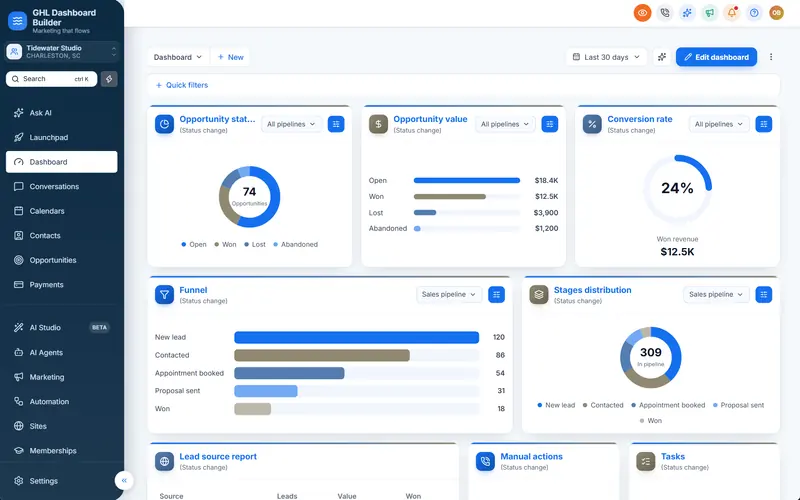
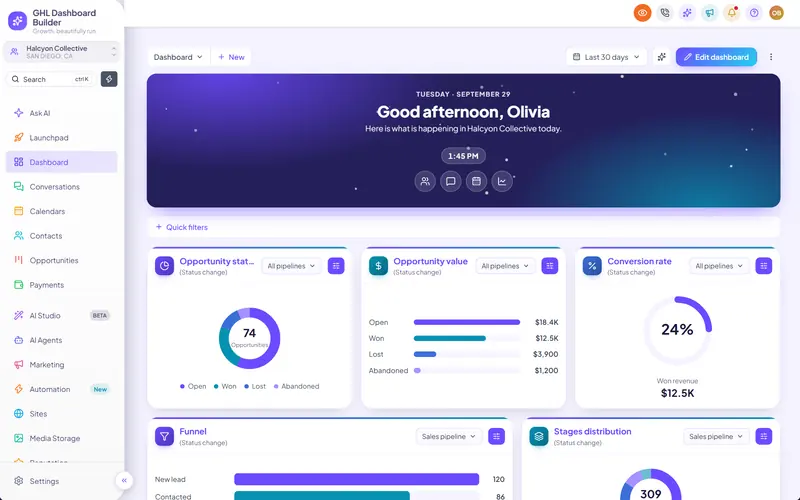
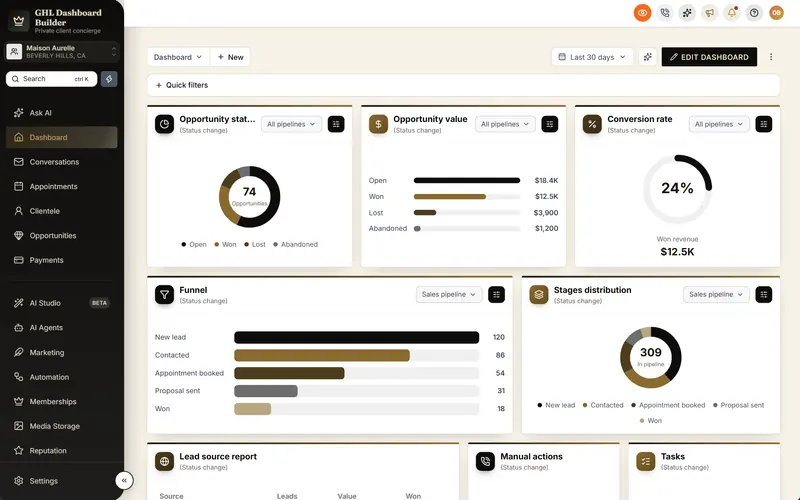
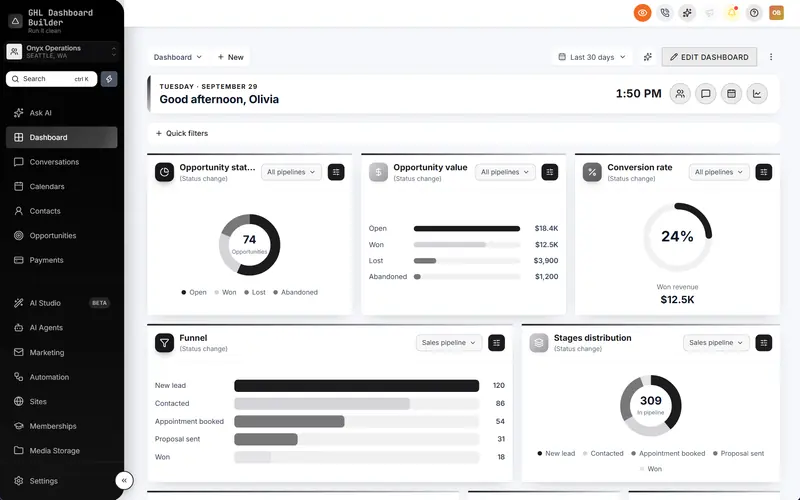
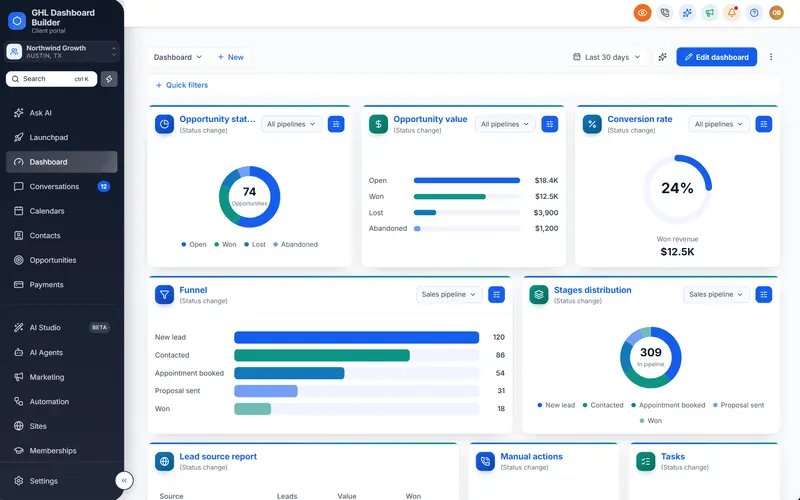
GHL Dashboard Builder is an independent design service that turns the standard HighLevel (GoHighLevel) dashboard into a branded platform: your colors, menu, login design, privacy mode and your clients’ language, installed with two lines of code. For Kuwait agencies the useful parts are Arabic and English menus, industry wording in the menu, designs limited to chosen sub-accounts, privacy mode and a branded sign-in page.
We design the look in our builder and install it for you as part of a one-time $100 setup fee: one CSS line and one JavaScript line in Settings, Company, Whitelabel, Custom Code, which takes about 5 minutes. After that, every client user who opens HighLevel in a browser sees the design. The builder never connects to your HighLevel account, and the installed code does not read or send your data, which is a short answer for a Kuwait client’s IT team. GHL Dashboard Builder is not affiliated with HighLevel.
| Feature | What it does for your Kuwait clients | Plan |
|---|---|---|
| Languages and right-to-left | HighLevel’s menu and navigation in Arabic, mirrored right to left, among 15 languages, with your own wording for any label | Pro and Agency |
| Noor templates | Two ready-made Arabic dashboards: right to left (Noor) or Arabic on a left-to-right layout (Noor LTR) | Pro and Agency |
| Menu editor | Rename, reorder and hide any of HighLevel’s 19 menu items: Patients, Bookings, Orders, Students | Pro and Agency |
| Templates | 31 templates, including Executive for firms and Serene for spas and salons, recolored to the client’s brand | All plans |
| Only these sub-accounts | A design shown only in the sub-accounts you choose, from one install | All plans |
| Privacy mode | An eye button that blurs names, emails, phone numbers, conversations and deal values | All plans |
| Login page design | 25 login designs on your white-label sign-in page, in your colors or your own gradient | Pro and Agency |
Each feature comes back in the sections below where it solves a specific Kuwait problem. The full list is on the features page. If you mainly want the identity side covered, our GoHighLevel white label dashboard page explains how a theme and HighLevel’s own white-label settings work together.
Should a Kuwait client’s HighLevel be in Arabic or English?
Often both, split by who uses it. Arabic is Kuwait’s official language, and many owners and Kuwaiti staff read it first, but most private-sector employees are expatriates who may work in English, Arabic or a mix. Ask each client who logs in daily, then give each group the language it reads fastest.
What the constitution and the market say
Article 3 of Kuwait’s constitution makes Arabic the official language of the state, as the Constitute Project’s English text shows. Government services, official letters and much public-facing material are in Arabic, and many Kuwaiti customers expect to be addressed in Arabic in messages and on landing pages.
Inside a business the picture is mixed. A clinic’s Egyptian receptionist may prefer Arabic, while an Indian or Filipino colleague at the next desk works in English. The owner may read Arabic reports and English marketing dashboards. A single “Kuwait language” setting does not fit that office, which is why the menu language deserves a short conversation with every client.
What HighLevel offers natively
HighLevel has begun translating its interface. HighLevel’s help center article on internationalization explains that a sub-account’s default language is set under Settings, Business Profile, Platform Language, and each user can change their own under Settings, My Profile. At the time of writing the list is mostly European languages, and the request for Arabic language support is still on HighLevel’s public ideas board. So an Arabic-first user in Kuwait sees an English HighLevel by default.
What a theme adds
A theme fills the gap for the menu and navigation. GHL Dashboard Builder translates HighLevel’s menu and navigation into Arabic, switches the layout to right to left and moves the sidebar to the right, with your own wording for any label. The Noor template starts from a finished Arabic design, and Noor LTR keeps the familiar left-to-right layout with Arabic words, which suits mixed Kuwait offices where English-first colleagues share the same screens.
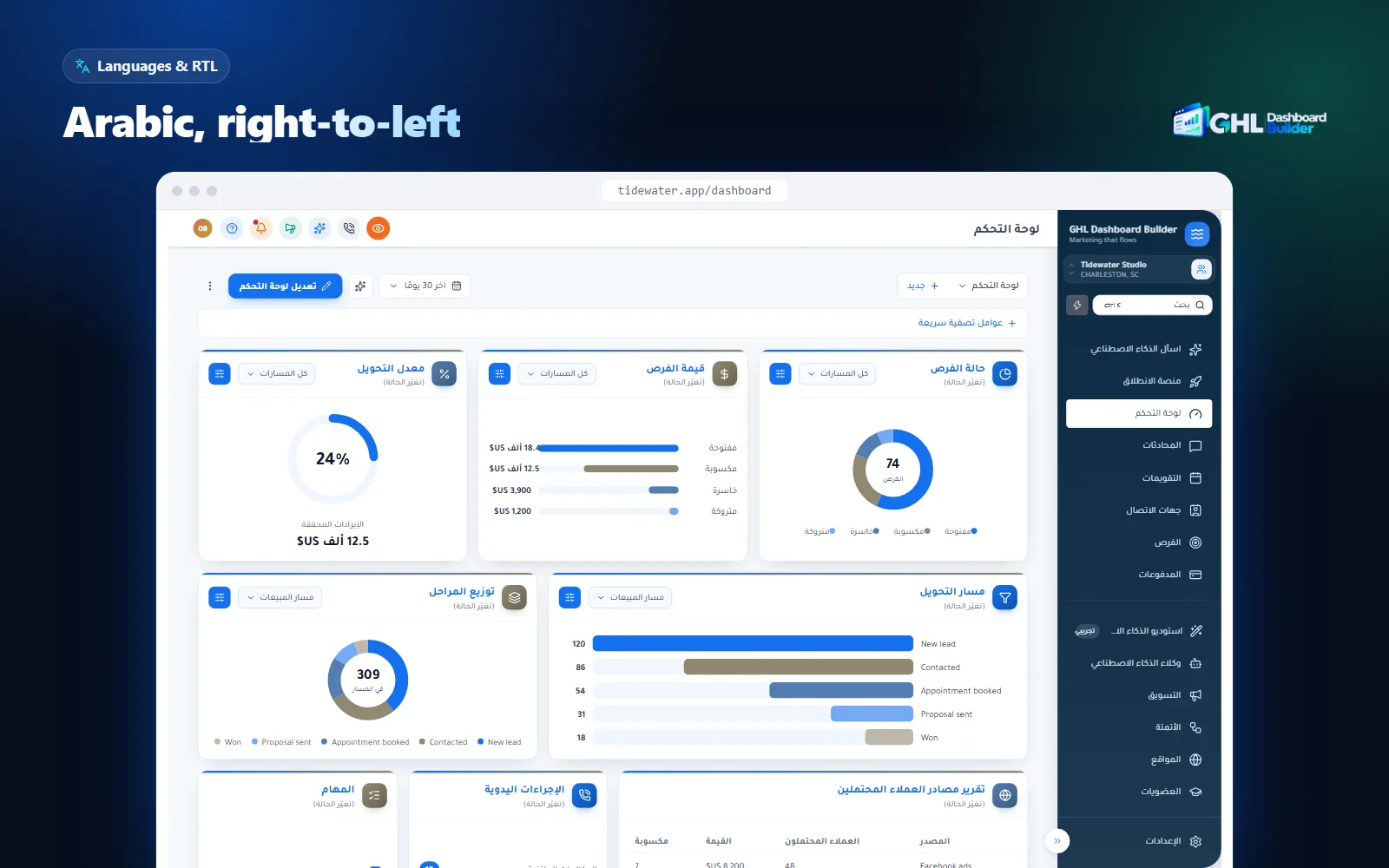
Two honest limits apply. Text inside HighLevel’s own pages, builders, system emails and the mobile app follows HighLevel’s language settings, so a theme does not translate the whole platform. And a theme does not write your clients’ content: Arabic messages, forms, funnels and invoice text are still written by people who know the language well, ideally in the Gulf register Kuwaiti customers expect. Our guide to giving clients an Arabic HighLevel dashboard goes deeper into what mirrors well and what to test.
How do you make the menu fit a mixed Kuwait team?
Rename HighLevel’s menu items to the client’s trade words, hide what the team never uses, and order the rest by daily importance. A short menu in familiar words helps a multilingual team more than any translation, because staff recognize “Bookings” or “Orders” faster than HighLevel’s generic “Contacts” and “Opportunities,” whatever their first language.
HighLevel’s default menu is built for agencies, not for a salon in Jabriya or a tutor in Mishref. It shows every module to every user, so a receptionist who only needs the calendar and the inbox scrolls past Sites, Memberships and Reputation every morning. In an office where several first languages meet, every unclear label costs a little training time and a few support questions.
GHL Dashboard Builder’s menu editor lets you rename, reorder and hide any of HighLevel’s 19 menu items, add New and Beta labels and add your own custom items. Combined with an Arabic or English design, that gives each client a menu in its own vocabulary:
- Clinic: Contacts becomes Patients, Calendars becomes Appointments, and Sites and Memberships are hidden for front-desk users.
- Salon or spa: Calendars becomes Bookings and moves to the top; Contacts becomes Clients.
- Online shop: Opportunities becomes Orders, Conversations stays near the top because most orders start in direct messages.
- Training center: Contacts becomes Students and Opportunities becomes Enrollments.
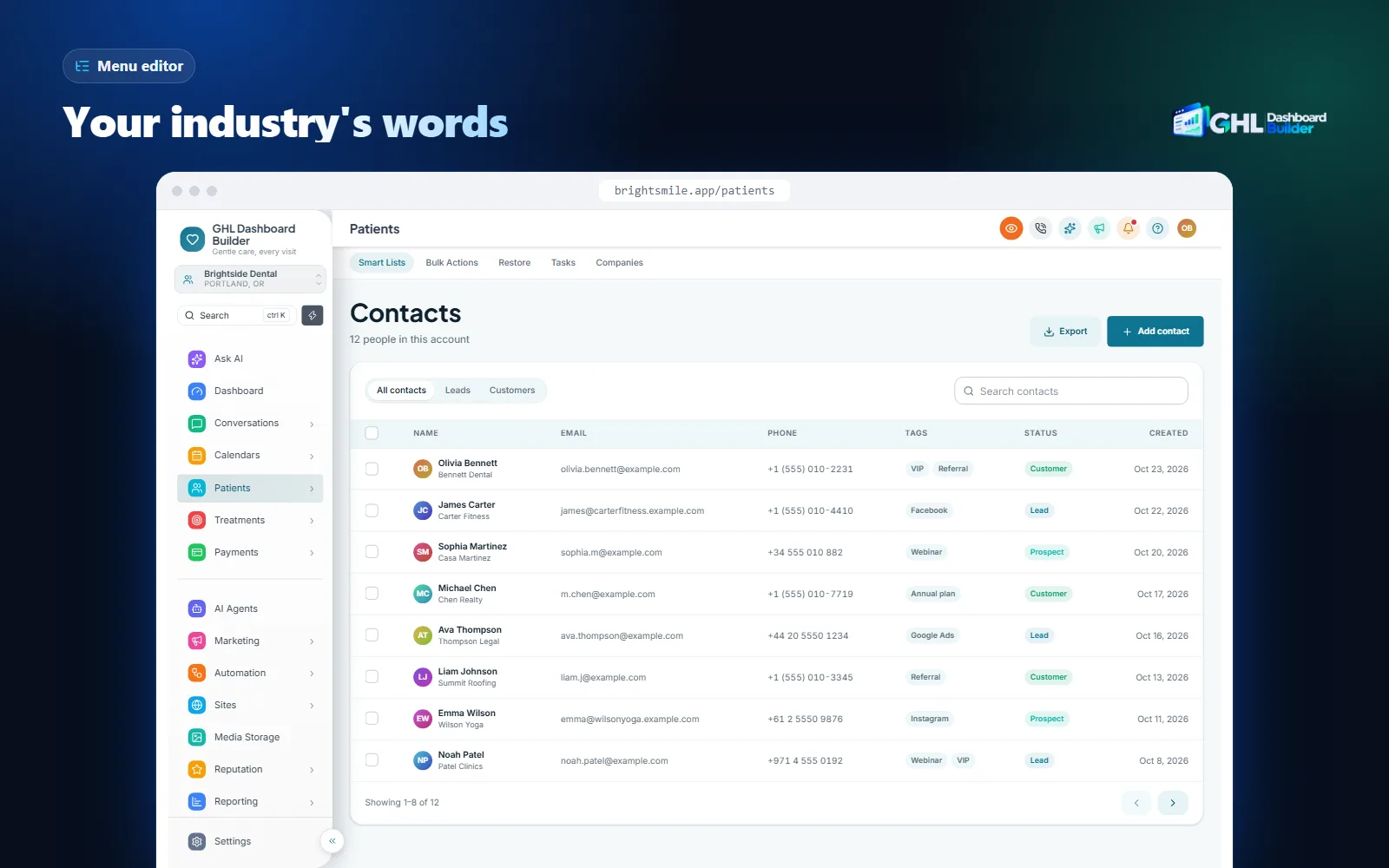
Industry templates give you a head start. The Serene template, in sage, blush and sand, is built for spas, salons and wellness studios and already renames Calendars to Bookings; the Serene template page shows it. For firms, the Executive template uses navy and muted gold with serif headings and top navigation; see the Executive template page. Our guide to renaming GoHighLevel menu items explains each item and what it controls, and the GHL sidebar and menu customization page shows the editor.
How should dinars, dates and the Kuwait week appear?
Show prices in Kuwaiti dinars (KWD) with three decimals, use the Asia/Kuwait time zone, and plan every automation around a Sunday-to-Thursday week with a Friday and Saturday weekend. These settings are small, but they decide whether invoices, reminders and reports feel local or imported.
Dinars, fils and invoices
The Kuwaiti dinar is divided into 1,000 fils, as Wikipedia’s entry on the dinar notes, so local prices are written with three decimals, such as KWD 12.750. Most software, including most invoice templates, assumes two decimals. Set the sub-account’s currency to KWD in its payment settings, then create a test invoice, estimate and payment link with a fils amount and check how HighLevel shows and rounds it before any real client sees one.
The dinar is not tied to the US dollar alone. In May 2007 Kuwait replaced its dollar peg with a peg to an undisclosed basket of currencies, as Al Jazeera reported at the time. The rate therefore moves a little against the dollar, which matters when you quote dollar-priced software or tools in dinars: say “about” and show the date of the rate you used.
Tax is simple for now. Kuwait signed the GCC VAT framework but has not introduced VAT, and reports on its 2026 to 2030 fiscal plan say VAT is not in it, as VATupdate reported. Build invoice templates so a tax line can be added later, and check the position with the client’s accountant before you quote.
The week and Ramadan
Kuwait moved its official weekend to Friday and Saturday from September 2007, as Asharq Al-Awsat reported, and banks and most companies follow the same Sunday-to-Thursday week. Many shops, restaurants, salons and gyms open on Friday and Saturday too, often for their busiest hours, so ask each client for its real hours instead of assuming.
Ramadan changes the rhythm every year. For Ramadan 2026, Kuwait’s Civil Service Commission set government working days at four and a half hours, as ARY News reported, and many private companies shorten hours too, while restaurants and shops shift their busiest times to the evening. Save a Ramadan copy of each client’s calendars and workflow time windows, ready to switch on when the month begins.
Dates, digits and phone numbers
Business documents use the Gregorian calendar, while Ramadan and the two Eids follow the Hijri calendar and move earlier each Gregorian year. Agree with each client whether Arabic text should use Western digits (0–9) or Arabic-Indic digits (٠–٩), and store phone numbers in the international +965 format so click-to-call, SMS and WhatsApp links work.
| Setting | Where in HighLevel | Kuwait value |
|---|---|---|
| Time zone | Settings, Business Profile | Asia/Kuwait (no daylight saving) |
| Currency | Payment settings | KWD, tested with a three-decimal fils amount |
| Phone format | Contact fields and imports | +965 followed by the local number |
| Working days | Workflow settings, Time Window; calendar availability | Sunday to Thursday, plus the client’s real Friday and Saturday hours |
| Ramadan hours | A saved copy of calendars and workflow windows | Shorter days and later evening peaks, switched on for the month |
| Platform language | Settings, Business Profile and My Profile | The language each user group reads best |
| Tax line | Invoice settings | None at the time of writing; ready to add if VAT arrives |
What do Kuwait’s data, commerce and advertising rules mean for HighLevel?
Kuwait has no single general data protection law at the time of writing, but three sets of rules still shape a HighLevel account: CITRA’s data privacy regulation, the 2026 digital commerce decree-law for anyone selling online, and Ministry of Health rules on health and beauty advertising. Ask each client which apply before you build forms, funnels and campaigns.
Data privacy
The main data protection instrument is the Data Privacy Protection Regulation issued by the Communication and Information Technology Regulatory Authority (CITRA) as Resolution No. 26 of 2024, which replaced a 2021 regulation, as Al Tamimi & Co explains. Later amendments narrowed its scope mainly to telecom and IT service providers licensed by CITRA, according to the Chambers data protection guide for Kuwait. Most of your clients are not CITRA licensees, but a bank, telecom partner or international group may have its own policies and send you written questions.
Good practice is the same either way: a consent checkbox and privacy link on every form in Arabic and English, only the fields the client needs, and user roles so staff only see the contacts and pipelines they work on. Keep medical details out of HighLevel unless the client and its advisers have decided otherwise.
Selling online
Kuwait’s 2026 digital commerce decree-law requires anyone advertising, promoting or selling goods and services online, including through social media and buy-and-sell apps, to register with the Ministry of Commerce and Industry first, as Kuwait Times reported. Sellers must also disclose prices, specifications and contact details clearly. For an Instagram-first client, that means asking for the registration before you build funnels and payment links, and putting full prices and contact details on every product and order page.
Health and beauty advertising
Clinics, salons and spas face their own rules. Al Tamimi & Co’s review of Kuwait’s public health and digital advertising oversight covers a 2025 Ministry of Health guide for salons, spas and beauty parlors and a planned licence for paid influencer advertising from the Ministry of Information. In a clinic or salon account, add an approval stage before any campaign goes live and store the approval reference on the campaign; the client stays responsible for the approval itself. This section is an overview, not legal advice.
Careful screens
Demos, support calls and training recordings are where client data leaks most often, because they show real names, phone numbers and order values to people outside the business. GHL Dashboard Builder’s privacy mode handles that part: an eye button in HighLevel’s header that, with one click, blurs contact names, email addresses, phone numbers, the conversation list and opportunity values while you share your screen, with a blur strength you choose. It is included on every plan. Privacy mode is a presentation tool, not access control, so it does not replace user roles. Our guide to hiding client data in GoHighLevel covers demo accounts and recordings in more detail.
How should SMS and WhatsApp work for Kuwait clients?
Register the SMS sender name before launch, write every template in Arabic and English, and route most customer conversations through WhatsApp and social inboxes where Kuwait customers already are. Messaging is where Kuwait setups most often fail in week one, because messages from an unregistered sender name can be blocked.
Twilio’s Kuwait SMS guidelines say alphanumeric sender ID registration is required for the Zain and Ooredoo networks, and that from 15 September 2026 messages with unregistered sender IDs to those networks are blocked. Providers also reject generic names such as INFO or SMS and expect the brand name in the sender ID; Unifonic’s Kuwait sender ID requirements list the documents, including a commercial license. Approval takes days, not hours, so check the current rules with whichever SMS provider the client’s HighLevel account uses before you promise a launch date.
A workable messaging setup for a Kuwait client:
- Register the sender name on day one. Start as soon as the client signs and collect the commercial license and signatory details the provider asks for.
- Separate reminders from marketing. Keep appointment reminders, order confirmations and payment receipts in their own workflows, apart from offers and newsletters.
- Write both languages. Write each template in Arabic and English and branch on a preferred-language field. Arabic SMS fits fewer characters into each message segment, so keep it short.
- Respect the week. Set workflow time windows to the client’s real days, avoid Friday midday prayers and late nights, and shift marketing sends later during Ramadan.
- Bring social messages into one inbox. Many Kuwait customers order and book through Instagram direct messages and WhatsApp. Connect the client’s channels through HighLevel’s own integrations so every conversation lands in one place.
The dashboard side matters too. A busy front desk answering messages in two languages needs to see what is waiting at a glance. GHL Dashboard Builder’s live counts put real numbers from HighLevel on the menu and in the welcome banner, such as unread conversations, appointments today and overdue invoices, so staff see the queue without opening every screen.
Should every Kuwait client get the same design?
Usually not. A Kuwait client list mixes Arabic-first family businesses, English-first firms, social-first shops and premium clinics that want “their own system.” Give your agency one consistent design and give the clients who need it their own, limited to their sub-accounts.
Reasons to treat some Kuwait clients differently:
- Language. A training center’s admissions team may want Arabic right to left, while a consultancy works in English.
- Brand rules. A franchise of an international brand must show the franchisor’s colors and fonts, not your agency’s.
- Trade wording. A clinic needs Patients, a salon Bookings and a shop Orders; one menu cannot say all three.
- Premium tiers. Some agencies sell a fully branded platform as a higher tier, and only those clients should see it.
- Pilots. You want to test a right-to-left design on one friendly client before rolling it out.
HighLevel’s Custom CSS and Custom JavaScript boxes sit at agency level, so by default whatever you paste there applies across your sub-accounts. A sub-account is one client’s workspace in HighLevel; HighLevel also calls it a location. To give one client a different look, the theme itself must know which sub-accounts to target. GHL Dashboard Builder does this with an “Only these sub-accounts” option: you add the client’s sub-account by its link or Location ID, that sub-account shows the design, and every other sub-account and the agency view keep plain HighLevel. You still paste one install code.
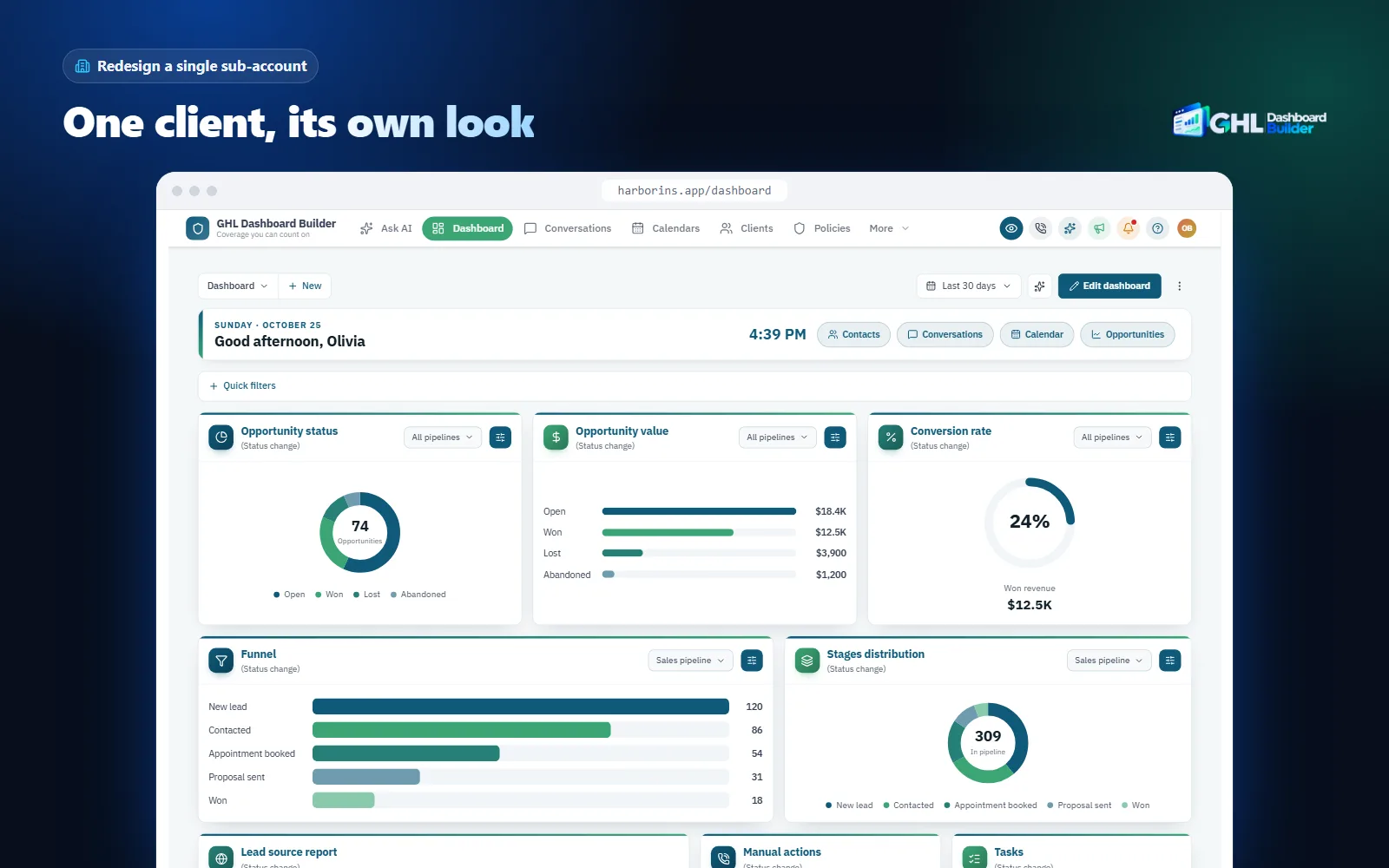
One install shows one design in the sub-accounts it targets. If you want, for example, an Arabic design for your Arabic-first clients and an English Executive design for your professional firms, Pro gives you up to 3 designs and Agency up to 100; talk to us about how to set them up across clients before you buy. Our guide to finding a HighLevel Location ID shows where to copy the ID, and the guide to GHL sub-account branding walks through the options in depth.
How do you set up white label HighLevel for a Kuwait client, step by step?
Prepare the sub-account’s local settings, build fields and pipelines in the client’s words, set up registered and bilingual messaging, then choose the design and install it on that one sub-account first. The steps below use a salon as the example and assume your agency’s identity layer is done and you have agency admin access. Menu paths follow HighLevel’s help center at the time of writing.
Infographic
A Kuwait client in HighLevelin six steps
- 1
Set local settings
Asia/Kuwait time zone, dinars with fils and the Sunday week.
- 2
Add the client's fields
Preferred language, consent and booking details.
- 3
Build the pipelines
Stages in the client's Arabic and English words.
- 4
Set safe messaging
Registered sender name, bilingual templates, quiet hours.
- 5
Pick the design
Arabic or English, a template and the client's colors.
- 6
Install and test
Two lines in Custom Code, then a morning with real staff.

Step 1: Local settings
- Open the client’s sub-account and go to Settings, Business Profile.
- Enter the business name and address as the client writes them, in Arabic and English if they use both, with the area and governorate, such as Salmiya, Hawalli.
- Set the time zone to Asia/Kuwait. Kuwait does not change its clocks, so timers stay predictable all year.
- In the payment settings, set the currency to KWD, then make a test invoice with a fils amount, such as 7.250, and check the display.
- Agree which digits to use in Arabic text, and set phone numbers to the +965 format.
Step 2: Fields for the client’s data
- Go to Settings, Custom Fields and click Add Field.
- Create a dropdown for preferred language (Arabic or English) on the contact, so messages and staff assignments can follow it.
- For a salon, add fields for preferred stylist, service type and last visit; for a shop, order channel (Instagram, WhatsApp, website) and delivery area.
- Add a text field for a consent reference and a date field for when consent was given.
- Group the fields in folders with clear names in the language staff read.
Step 3: Pipelines and stages
- In Opportunities, Pipelines, create one pipeline for new clients and one for packages or memberships.
- Name the stages in the client’s words, for example Enquiry, Booked, Visited, Package sold, Rebooked.
- If staff use Arabic, agree the Arabic stage names with the client and use them consistently in reports.
Step 4: Messaging and automations
- Start the SMS sender name registration with the client’s provider on day one.
- In each workflow, open Settings and set the Time Window to the client’s real working days and hours, including Friday and Saturday where they open.
- Add a condition that stops marketing workflows when the contact is on Do Not Disturb or has no consent reference.
- Write every template in Arabic and English and branch on the language field.
- Save a Ramadan copy of calendars and workflow windows, with later evening hours, ready to switch on.
Step 5: Choose the design
- Open the free builder and start from Serene for a salon or spa, Executive for a firm, or Noor for an Arabic-first client.
- Set the client’s colors, logo and business name, and rename menu items to the client’s words, such as Clients and Bookings.
- Turn on privacy mode, pick a login design, and check the preview on desktop, tablet and phone.
Step 6: Install and test on this sub-account
- In the agency view, open Settings, Company, Whitelabel and find the custom code area. On every plan we do this for you as part of the setup fee.
- Copy anything already in Custom CSS and Custom JavaScript into a text file. That is your rollback.
- Paste the theme’s CSS line and JavaScript line, then save. HighLevel warns about third-party scripts; confirm only if you trust the code.
- If the design is limited to chosen sub-accounts, confirm this client’s sub-account is on the list.
- Open the sub-account in a new tab, hard-refresh, and walk through the dashboard, conversations, calendars, contacts and the opportunities board.
- Ask two staff members, one who works in Arabic and one in English, to use it for a morning and tell you which labels confuse them.
| Step | What is done | Who should be involved |
|---|---|---|
| 1. Local settings | Business profile, time zone, KWD with fils test, digits, phone format | Your setup specialist |
| 2. Fields | Preferred language, booking or order details, consent reference | The client’s operations person |
| 3. Pipelines | New-client and package pipelines with the client’s stage names | The salon manager or sales lead |
| 4. Messaging | Sender name, time windows, consent stops, bilingual templates, Ramadan copy | Your automation builder and the SMS provider |
| 5. Design | Template, colors, menu wording, privacy mode, login design | Your designer and the client’s owner |
| 6. Install and test | Two lines in Custom Code, a morning with Arabic- and English-speaking staff | Your setup specialist and two client users |
What can go wrong, and what doesn’t a theme solve?
Most problems in Kuwait setups come from unregistered sender names, two-decimal assumptions, weekday settings copied from another market and the belief that a branded dashboard covers the rules. A theme changes how HighLevel looks and reads; messaging approvals, commerce registration and advertising approvals are met by how you configure the account and how the client works.
| Problem | Why it happens | What to do |
|---|---|---|
| Reminder SMS never arrive | The sender name was not registered with Zain and Ooredoo | Register it on day one; use only the registered name in workflows |
| Invoice totals look wrong | A two-decimal template or rounding on a three-decimal fils price | Test a fils amount before launch and agree the display with the client |
| Messages go out during Friday prayers | Workflow time window left on “any time” or a Monday-to-Friday week | Set Sunday-to-Thursday windows plus the client’s real weekend hours |
| Staff ignore the new menu | Labels in one language for a mixed team | Use the client’s own words and the right language for each user group |
| A franchise sees your agency’s colors | One design applied to every sub-account | Limit each design to the right sub-accounts |
| An online shop’s funnel lacks required details | Product pages copied from another market | Add price, specifications and contact details; confirm the MOCI registration |
| Part of the theme looks wrong after an update | HighLevel changed a screen | Re-check after HighLevel releases; keep the previous code to roll back |
There are also limits no theme removes. HighLevel does not officially support custom code, so a platform update can require a theme refresh; Starter and Pro include 12 months of updates that cover this, and Agency includes lifetime updates. A theme works in the web browser; it does not change HighLevel’s mobile app, its system emails or your clients’ content. The installed code does not change HighLevel’s login page by itself yet; we design and set up the login look with you. And a theme cannot register sender names, collect consent or obtain commerce and advertising approvals.
What does a branded HighLevel dashboard cost a Kuwait agency?
GHL Dashboard Builder has three one-time plans with no monthly fee, plus a one-time $100 setup fee on every plan, for which we install and configure the design in your HighLevel. For agencies with Arabic-speaking clients or mixed teams that need renamed menus, Pro is the usual starting point, because it includes the Arabic menu, the Noor templates, the menu editor and the login designs.
We bill in US dollars. On 22 October 2026 the Central Bank of Kuwait rate was 0.3080 dinars per dollar, as listed by AllRatesToday. At that rate Starter ($280) is about KWD 86, Pro ($480) about KWD 148 and Agency ($880) about KWD 271, plus about KWD 31 for the setup fee. Because the dinar follows a currency basket, these dinar amounts move slightly with the rate.
Which plan fits depends on the client mix:
- Starter ($280 one-time, plus the $100 setup fee) gives one branded design from any of the 31 templates, with colors, fonts, sidebar, header, buttons, the welcome banner, the appointments board, live figures on the Dashboard, notification pop-ups, privacy mode and sub-account targeting. It suits an agency whose Kuwait clients all work in English and share one look.
- Pro ($480 one-time, plus the $100 setup fee) adds up to 3 designs, every editor option, the menu editor, 15 languages including Arabic right to left, the two Noor Arabic dashboards, top navigation and 25 login designs. It suits most Kuwait agencies, for example one Arabic design and one English design with trade wording.
- Agency ($880 one-time, plus the $100 setup fee) adds up to 100 designs, one look designed from scratch by our team, custom CSS and JavaScript, downloadable code files and lifetime updates. It suits agencies that brand many clients separately.
Starter and Pro include 12 months of updates, then optional at $99 a year; without them the theme keeps working as it is. You can resell the branded dashboard to your clients at your own price; we take no share and charge no per-client fee. Current details are on the pricing page, and our FAQ answers questions about installing, removing and data.
What to do next
- List your Kuwait clients by type: clinic, salon or gym, online shop, restaurant, training center or professional firm. That list tells you which fields, pipelines and rules each sub-account needs.
- For each client, write down who logs in and which language each group reads best, then decide between an Arabic right-to-left menu, Arabic on a left-to-right layout, or English with trade wording.
- Fix the Kuwait basics first: Asia/Kuwait time, KWD tested with fils, Sunday-to-Thursday windows, a registered sender name, consent on every form and, for online sellers, their commerce registration.
- Try the client’s colors and menu wording in the free builder, starting from Serene, Executive or Noor, and install on one sub-account before any others.
- If you also serve clients elsewhere in the Gulf, compare this setup with our guides to white-labeling HighLevel in Qatar and white-labeling HighLevel in Saudi Arabia.